


“When the day of Pentecost arrived, they were all together in one place. And suddenly there came from heaven a sound like a mighty rushing wind, and it filled the entire house where they were sitting. And divided tongues as of fire appeared to them and rested on each one of them. And they were all filled with the Holy Spirit and began to speak in other tongues as the Spirit gave them utterance.
Now there were dwelling in Jerusalem Jews, devout men from every nation under heaven. And at this sound the multitude came together, and they were bewildered, because each one was hearing them speak in his own language. And they were amazed and astonished, saying, ‘Are not all these who are speaking Galileans? And how is it that we hear, each of us in his own native language? Parthians and Medes and Elamites and residents of Mesopotamia, Judea and Cappadocia, Pontus and Asia, Phrygia and Pamphylia, Egypt and the parts of Libya belonging to Cyrene, and visitors from Rome, both Jews and proselytes, Cretans and Arabians—we hear them telling in our own tongues the mighty works of God.’
And all were amazed and perplexed, saying to one another, ‘What does this mean?’ But others mocking said, ‘They are filled with new wine.’
But Peter, standing with the eleven, lifted up his voice and addressed them: ‘Men of Judea and all who dwell in Jerusalem, let this be known to you, and give ear to my words. For these people are not drunk, as you suppose, since it is only the third hour of the day. But this is what was uttered through the prophet Joel:
“And in the last days it shall be, God declares,
that I will pour out my Spirit on all flesh,
and your sons and your daughters shall prophesy,
and your young men shall see visions,
and your old men shall dream dreams;
even on my male servants and female servants
in those days I will pour out my Spirit, and they shall prophesy.
And I will show wonders in the heavens above
and signs on the earth below, blood, and fire, and vapor of smoke;
the sun shall be turned to darkness and the moon to blood,
before the day of the Lord comes, the great and magnificent day.
And it shall come to pass that everyone who calls upon the name of the Lord shall be saved.”’”
– Acts 2:1-21
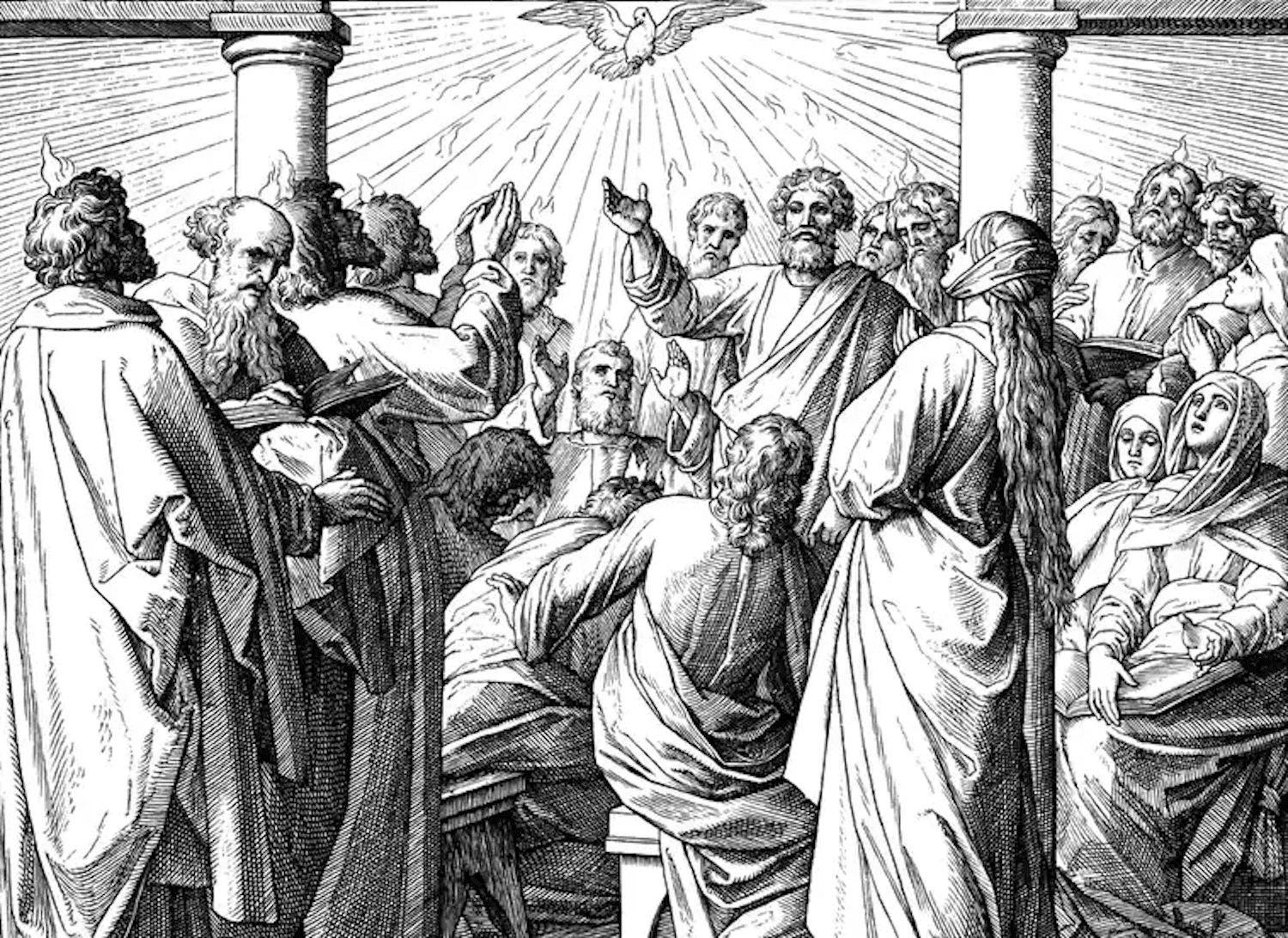
As we make our way through the season of Lent, this time of penitent fasting in preparation for Easter feasting (a time of training us for kingship), our focus is fittingly drawn to the resurrection of Jesus. The empty tomb. The victory of Christ over the principalities and powers of this world. A time of celebration as we join the host of heaven in singing: “Where is thou victory O death? Where is thou sting?”
But our attention should also be upon the spiritual harvest of which Jesus’ resurrection is the first fruit. The bumper crop the Bible refers to as the New Creation. Indeed, according to Peter’s Pentecostal sermon here in Acts 2, Jesus’ resurrection inaugurates a whole new age in the history of the world. One marked by significant changes in the life and mission of God’s people.
Behind the fulfillment of that change is a new work of the Spirit. One involving a complete renovation of the cosmos. Extreme makeover, the universe addition. For it’s not just creatures who groan inwardly for redemption, but the whole creation, says Paul in Romans 8. Indeed, this is the crowning promise of the new covenant. To make all things new. And it’s a work that began on Pentecost (in Acts 2) with the outpouring of the Spirit.
The festival of Pentecost occurs fifty days after Passover, and it’s accompanied by the feast of weeks which celebrated the first fruits of the wheat harvest. Thus, in this text we are witnessing the first fruits of the Spirit’s harvest among believers as they receive the gift of the indwelling Spirit. The regeneration of their souls. The sign of which is the sound of rushing wind (Spiritus, pneuma, breath or wind) and the tongue speaking of the disciples, the spontaneous utterance in unknown languages, as men from all over the empire who have made the pilgrimage to Jerusalem (and have come to see what the commotion is about), each hear the message in his own “tongue.”
This is evidence, says Peter, not of drunkenness, but that Jesus has sent the Spirit and that the new age has begun, just as the prophet Joel had predicted. An age which is marked by a return to man’s true vocation as ruling priest. Which is his original mandate.
“Be fruitful and multiply and fill the earth and subdue it, and have dominion over the fish of the sea and over the birds of the heavens and over every living thing that moves on the earth.” – Genesis 1:28
A RESTORATION OF FALLEN SOCIETIES
Some have called this the cultural mandate (a garden metaphor, turning the garden into a garden city), or the creation mandate (we are sub-creators). We might also call it the dominion mandate. A vocation to rule the earth as God’s vice regent. A return to kingship. Or again using a cultic metaphor of a return to our priestly duties (There is a lot of temple language in this text: man standing at the liminal space between heaven and earth. Indeed, working to bring the two back together). A vocation regained when man is raised from spiritual death, freed from his bondage to sin and Satan, pictured in his rising from his burial in baptism, and is exalted with Christ and seated with him in the heavenly places. (Ephesians 2:6 above) (An expression many commentators fail to see the full import of).
Seated with Christ means at the right hand of God. The seat of authority. And thus, it is not just a spiritual resurrection that one experiences when becoming a Christian, but also an ascension and coronation. To be born again, means to be born a prince. To be “born from above” is what this phrase literally says. To be born a rightful heir to the kingdom of God.
Having his regency reestablished, man’s mandate is to renew and reclaim what rightfully belongs to his father (the King), everything (Deuteronomy 10:14-17; Isaiah 11:10-11):
“Yours, O Lord, is the greatness and the power and the glory and the victory and the majesty, for all that is in the heavens and in the earth is yours. Yours is the kingdom, O Lord, and you are exalted as head above all.” – 1 Chronicles 29:11
All power and authority (in heaven and earth) have been given to me, says Prince Immanuel. Now go make disciples of the nations. This is the work of new creation. Redeeming not just souls, but entire societies. Not just neighbors, but nations. For is there not one square inch of this earth which does not belong to Christ and that he does not want to redeem?
“The silver is mine, and the gold is mine, declares the Lord of hosts.” – Haggai 2:8
“For every beast of the forest is mine, the cattle on a thousand hills.” – Psalm 50:10
“For ‘the earth is the Lord's, and the fullness thereof.’” – 1 Corinthians 10:26
Not just creatio continua—turning the garden into a garden city, but creatio ex vetere (“creation out of the old“)— a restoration of fallen souls (through evangelism) and fallen societies (through renewing the culture). This is our high calling. This is our mission.
It is why Acts 2 is a central text for COTS. For our mission statement is to revive the church, reach the city, and renew the culture. This afternoon marks the beginning of a series of lessons (that we will come back to from time to time) on this (new) creation mandate.
What I want to do now, as a further introduction, is to flesh out this new work of the Spirit, as Peter does in Acts 2, by demonstrating its scriptural foundation. To not only prove its fulfillment in our hearing, but to demonstrate its significance and scope. So that we might realize just how privileged we are to be among those who have received (at least the down payment of) this power (A day the prophets of old longed to see. What all of the great heroes of faith listed in Hebrews 11 sacrificed to bring about but never received the benefits of). A Christian privilege that for far too long has been neglected. But one which we must embrace if Western civilization is to be saved.
The resurrecting work of the Spirit (the work of new creation) is foreshadowed in a number of prominent, Old Testament texts, texts prophesying the coming of the new covenant. We are going to focus upon those in Isaiah. Who might rightly be called the prophet of the new creation.
For example, Isaiah 32:15 tells us that Israel will lie in desolation...
“Until the Spirit is poured out upon [them] from on high, and the wilderness becomes a fertile field, and the fertile field is considered as a forest.”
A similar prophecy is found in Isaiah 44:3–4:
“For I will pour out water on the thirsty land and streams on the dry ground; I will pour out my Spirit on your offspring and my blessing on your descendants; and they will spring up among the grass like poplars by streams of water.”
Isaiah 43:19–20 likewise refers to this reviving work of the Spirit:
“Behold, I will do something new, now it will spring forth; will you not be aware of it? I will even make a roadway in the wilderness, rivers in the desert. The beasts of the field will glorify me, the jackals and the ostriches, because I have given waters in the wilderness and rivers in the desert, to give drink to my chosen people.”
Notice the symbolism being used by the Isaiah. As befits a culture with a dry climate where water is scarce, these prophecies depict the coming of the Spirit in the image of the outpouring of a life-giving flood (Three months without rain, a mini-drought which gave us a taste of it here in Texas).
A promise to give rivers of water, abundant refreshment to those whose soul thirsts. The power to not only revive the desert, but to turn it into a lush meadow, or a dense forest. Which speaks of the complete transformative nature of the outpouring, but also to the vastness of its scope. The overwhelming success of the Spirit’s mission. For even the jackals and the ostriches will praise him!
The aggressive and the cowardly. An optimism which the kingdom parables in the Gospels share. That the kingdom of God is like a mustard seed which grows into the largest tree of all. Or leaven which infiltrates the whole lump, etc.
The point is, that the world has become dry and desolate. A culture of death and destruction reign over it. A spiritual wasteland. And it is only through the outpouring of the Spirit that it can be revived. This figure is also used in the text that Peter cites in his sermon, Joel 2:28– 32a:
“It will come about after this that I will pour out my Spirit on all mankind;
and your sons and daughters will prophesy,
your old men will dream dreams,
your young men will see visions.
Even on the male and female servants I will pour out my Spirit in those days.
I will display wonders in the sky and on the earth, blood, fire and columns of smoke.
The sun will be turned into darkness and the moon into blood before the great and awesome day of the Lord comes.
And it will come about that whoever calls on the name of the Lord will be delivered.”
DOMINION VS DOMINATION
Now, I take the prophesy, dreams and visions described here to be the signs of the Spirit’s arrival, not specifically the works he has come to do. Some wish to reduce the Spirit’s project to tongue speaking and other forms of ecstatic speech. But such are the confirmatory signs that we are in the last days, says Joel.
We don’t want to confuse the power of resurrection with the signs of its arrival. The reality with the shadow. A perennial problem in the history of Christianity. If all that the Spirit has come to do is provide us with the ability to speak in foreign languages, then we are of all people most to be pitied.
For, unless we are given the Spirit without measure, our renovation project will never even get off the ground. Without the power of the resurrection we would still be a persecuted religious minority in the Roman Empire. For the same power that transformed the world then (that turned it upside down), will transform the world now (Many people today, including many Christians have become so accustomed to the world being upside down that when you try to right it they view you to be some kind of extremist).
GK Chesterton: “We shall soon be in a world in which a man may be howled down for saying that two and two make four, in which furious party cries will be raised against anybody who says that cows have horns, in which people will persecute the heresy of calling a triangle a three-sided figure and hang a man for maddening mob with the news that grass is green.”
John the Baptist, the last of the Old Testament prophets, also uses water symbolism to speak of the Spirit’s resurrecting work. For example, John distinguished himself from Jesus thusly:
“As for me, I baptize you with water for repentance, but he who is coming after me is mightier than I, and I am not fit to remove His sandals; he will baptize you with the Holy Spirit and fire.” - Matthew 3:11
And John tells us that this metaphor did not originate with him. For in his testimony about Jesus he says:
“I did not recognize him, but he who sent me to baptize in water said to me, ‘he upon whom you see the Spirit descending and remaining upon him, this is the one who baptizes in the Holy Spirit.” – John 1:33
Jesus reminds his apostles of this promise in his final instructions to them:
“For John baptized with water, but you will be baptized with the Holy Spirit not many days from now.” – Acts 1:5
The preposition “with” or “in” here indicates the element in which one is immersed; in John’s baptism it is water, in Jesus’ baptism it is the Spirit. This promise also identifies Jesus as the agent performing the baptism. So the image in this promise is that of receiving power from on high by being baptized or immersed by Jesus in the Spirit, just as John was immersing repentant sinners in water.
Meaning that if you are a Christian, this is the gift that you received at your immersion. The resurrecting power of the indwelling Spirit. You have been clothed in power from on high and seated at the right hand of God, so that you might return to your true vocation as vice regent of this world. Carrying on the work of new creation. Meaning that you are now responsible not only for your own faithfulness, but the faithfulness of your family and your larger community.
As vice regent you cannot say, “Oh it’s none of my business” that the library is hosting a drag queen story hour. Or, that the school district is queering the children of Georgetown. No more than you could say that it’s none of your business that your neighbor is an unbeliever. Such matters are your business. For you are a vice regent of the God most high. And he will hold you accountable for your stewardship of his world.
The continuity of thought then, is that the Holy Spirit will be poured out in such abundance—think of Victoria Falls—that his presence will be like flowing rivers (Isaiah 43:20) and streams (Isaiah 44:3) in which one may be completely immersed in its life-giving power (in Victoria Falls you can be 500 yards from it and still get drenched just by its mist, which rises above the tree line and the thundering can be heard from great distances, called “the smoke that thunders”) This is the power of the Spirit that has been unleashed, where to even approach it means you will get drenched by its spray. An outpouring that millennia of Old Testament saints longed to witness and who sacrificed much to clear the way for, has now come.
This is the Good News that Peter preaches on Pentecost in the first gospel sermon of the new age. That the Spirit of God has been poured out by King Jesus and that it is to be freely given to everyone who believes.
And yet what most Christians want, it seems, is just a sprinkling of this Spirit. Just the bare minimum to keep them alive. A spritz of the Spirit, here and there. Once a week on Sunday. When instead they should be diving, head-first, into its flood. Fully immersing themselves in its resurrecting power. Being caught up in its current.
The idea of immersion is being overwhelmed by the power of the Spirit. Or, to drink it in! Come and drink deeply from the river of salvation, God beacons us in Isaiah 12:3 (Peter could have said to those in his audience who were grumbling: these men are not intoxicated by wine, but by the Spirit).
Are you drunk on the Spirit?
Are you under its influence?
This promise, brethren, this new work of the Spirit is epic in scope. Does your life reflect the truth of it?
And here’s the thing. It’s even bigger than all this. For this baptism is not just for individuals. The Old Testament speaks of the entire world being drowned in the Spirit’s flood. As in Isaiah chapter 11 (another foundational text for COTS) where “the world [is] filled with the glory of God, as the waters cover the sea.” Which speaks of God's intention to flood the earth with himself, with his holiness and love in new ways, returning the beauty and power and majesty of the creation.
This is the rejuvenating work of the Spirit. Pre-figured by the flood during the time of Noah. Which, as Peter says, cleansed the earth of wickedness. It is also pre-figured in Israel being baptized in the Red Sea as they are leaving Egyptian bondage and headed to the promised land.
Our world (indeed, our society) is in need of the Spirit’s baptism again. We need to immerse not just our families and churches in the resurrecting Spirit, but our towns and cities and even our nation. We need to immerse Georgetown in the Spirit of God. This is our mission. This is our calling. This is our true vocation.
These are the good works that God has prepared beforehand that we should walk in them. And it begins not, as you might think, with an assertion of your will. It begins with surrendering your will to the Spirit. Not self-assertion, but self-denial.
As we will see in a future lesson, there is a world of difference between dominion and domination. Dominion builds a flourishing garden city. Domination builds Babel. The first comes by the surrendering of one’s will. The second by asserting it.
As you did in your baptism, surrender yourself to the resurrecting power of the Spirit. So that you might return to your true vocation.
“And do not get drunk with wine, for that is dissipation, but be filled with the Spirit.” – Ephesians 5:18
Video Link: Resurrection Power: The Christian Privilege - YouTube